

Ever felt sudden, crushing anxiety or anger just before your period? Wondered if it’s PMDD or the start of perimenopause?
This guide offers a clear answer. PMDD and perimenopause both cause mood swings due to hormones. But they differ in timing, pattern, and treatment. PMDD symptoms peak in the two weeks before your period and then go away. Perimenopause symptoms can be ongoing or tied to irregular cycles as estrogen changes.
You’ll learn to spot PMDD versus perimenopause symptoms. We’ll cover what causes each, how to track your cycles, and treatments to talk about with your doctor. This guide is reviewed by Dr. Helloyze Ferreira Ancelmo (CRM-GO 31293). It includes comparisons, evidence summaries, and real-world approaches for women in the United States.
Key Takeaways
- PMDD is cyclical and tied to the luteal phase; perimenopause often causes erratic, sometimes continuous symptoms.
- Psychological symptoms like severe depression and anxiety are more prominent in PMDD; perimenopause may add brain fog and sleep disruption.
- Track symptoms across 2–3 cycles to spot patterns before concluding pmdd vs perimenopause.
- Treatments differ: SSRIs, drospirenone pills, and CBT help PMDD; HRT and nonhormonal options address perimenopause.
- Lifestyle changes—exercise, nutrition (omega-3, calcium, vitamin D), and reduced alcohol/caffeine—can ease both conditions.
- Resources on symptom overlap and supplements can help; see this expert overview on PMS, PMDD, and perimenopause and a discussion of menopause mental health for deeper reading.
Quick Answer
PMDD happens after ovulation and goes away with your period. Perimenopause is a longer phase before menopause. It’s marked by unpredictable hormone swings and irregular cycles.
Timing and pattern are key to diagnosis. If symptoms only show up before your period, you might have PMDD. But if you experience mood changes, hot flashes, or irregular periods all month, you’re likely in perimenopause.
Both conditions can share symptoms like mood swings and fatigue. Look for hot flashes and changes in menstrual frequency for perimenopause. A symptom-free week in the follicular phase points to PMDD.
Keep a symptom journal for at least two cycles. Use apps like Clue or Flo to track. Then, talk to a doctor about your findings.
| Feature | PMDD | Perimenopause |
|---|---|---|
| Typical timing | Predictable luteal phase, resolves after menses | Unpredictable timing, symptoms may persist across cycle |
| Hormone pattern | Normal cycle hormones but abnormal sensitivity to luteal changes | Erratic estrogen and progesterone fluctuations, changing cycles |
| Common overlapping symptoms | Mood swings, anxiety, fatigue, brain fog | Mood swings, anxiety, fatigue, brain fog |
| Distinctive signs | Consistent symptom-free follicular week | Hot flashes, night sweats, irregular bleeding |
| Best next step | Two-cycle symptom tracking and clinical review | Cycle history, symptom log, consider hormone testing |
Key Takeaways
It’s important to know the difference between PMDD and perimenopause. Use daily symptom tracking to spot the pattern. PMDD causes severe mood and physical symptoms that appear in the luteal phase and lift after menstrual bleeding.
Perimenopause brings erratic estrogen and progesterone shifts. This leads to irregular cycles, hot flashes, sleep disruption, and more persistent mood or cognitive changes.
Recall the hormonal drivers. PMDD links to sensitivity to progesterone metabolites such as allopregnanolone. Perimenopause involves fluctuating estrogen and progesterone levels over months to years. This hormonal mood changes summary helps you understand timing and persistence of symptoms.
Treatments differ by diagnosis. For PMDD, selective serotonin reuptake inhibitors, certain combined oral contraceptives like Yaz, and targeted lifestyle measures are common. For perimenopause, hormone therapy and symptom-based approaches for vasomotor and sleep issues are typical. Some people benefit from supplements such as zinc or calcium, under clinician guidance.
Both conditions can co-occur. If you had PMDD earlier in life, perimenopause can worsen mood symptoms or change their pattern. Diagnostic tools include daily charts for PMDD and supportive labs like FSH or estradiol for perimenopause. The DSM criteria for PMDD require specific symptom counts and clear cyclical timing.
Escalation options exist but carry risks. Refractory PMDD may be treated with GnRH agonists such as leuprolide (Lupron) or with bilateral oophorectomy, approaches that induce menopause and often require add-back therapy and careful counseling. Discuss risks and benefits with a gynecologist or a reproductive psychiatrist.
Keep this list of key takeaways pmdd and perimenopause handy when you talk with your clinician. A focused hormonal mood changes summary and consistent symptom tracking make evaluation more accurate. They help guide safer, more effective treatment choices.
What Is PMDD?
Premenstrual dysphoric disorder (PMDD) is a severe form of premenstrual syndrome. It happens in the luteal phase, about one to two weeks before your period. Symptoms go away within days of your period starting and come back with the next cycle.
Diagnostic Criteria
To diagnose PMDD, you need to have at least five of eleven core symptoms in most menstrual cycles over the past 12 months. One of these symptoms must be mood-related. Symptoms should happen in the week before your period, get better within a few days after it starts, and be minimal after.
Doctors first check for other psychiatric disorders like major depression or bipolar disorder. To confirm PMDD, tracking symptoms for two menstrual cycles is the best way. But, an experienced doctor can make a first assessment.
Common Symptoms
The list below shows the 11 symptoms used in clinical practice. You might experience some or many of these, with varying intensity.
- Depressed mood, hopelessness, or self-deprecation
- Marked anxiety or tension
- Affective lability: mood swings, tearfulness, rejection sensitivity
- Anger or irritability that causes arguments or problems
- Decreased interest in usual activities
- Difficulty concentrating
- Lethargy, low energy, or fatigue
- Appetite changes or specific food cravings
- Sleep disturbance: insomnia or hypersomnia
- Feeling overwhelmed or out of control
- Physical symptoms: breast tenderness, joint or muscle pain, headache, bloating
Research shows PMDD comes from a heightened central nervous system response to hormones. Many people with PMDD are more sensitive to progesterone, which changes their brain circuits.
A key player is allopregnanolone, a hormone that normally calms the brain. In PMDD, it can trigger anxiety and irritability in some people.
Treatment often starts with selective serotonin reuptake inhibitors. These can be taken continuously, during the luteal phase, or at symptom onset. Combined oral contraceptives, like Yaz or Nexstellis, may also help by stopping ovulation.
Lifestyle changes, dietary supplements like zinc, calcium, and magnesium, and targeted counseling can also help. For severe cases, options include GnRH agonists or surgical removal of the ovaries, with careful counseling about menopause and hormone replacement therapy.
| Category | Key Points |
|---|---|
| Timing | Symptoms occur in luteal phase, improve within days of menses, minimal after period |
| Diagnostic Threshold | At least 5 of 11 symptoms in most cycles for 12 months; one mood symptom required |
| Pathophysiology | Heightened CNS response to normal hormones; progesterone sensitivity and altered response to allopregnanolone |
| First-line Treatment | SSRIs (multiple dosing strategies); combined OCPs with drospirenone are options |
| Escalation | GnRH agonists (leuprolide); surgical oophorectomy with hormone replacement counseling |
| Practical Steps | Begin prospective symptom tracking; seek clinicians via reproductive psychiatry and menopause societies; emergency help if suicidal |
What Is Perimenopause?
Perimenopause is the time leading up to menopause, lasting 12 months without a period. Your ovaries start making hormones in unpredictable patterns. You might see changes in your cycle, unpredictable bleeding, and other physical and mental changes.
Hormonal Changes During Perimenopause
Estrogen levels go up and down a lot during perimenopause. This makes your cycles unpredictable. A single blood test might not show the whole picture.
Follicle-stimulating hormone (FSH) levels can change a lot. Hormones affect many parts of your body, causing a wide range of symptoms. These can include hot flashes, mood swings, and skin changes.
Because hormones are so unpredictable, it can be hard to tell if you have PMDD or perimenopause. If you have symptoms like hot flashes and irregular periods, it’s likely perimenopause.
Typical Age Range
Perimenopause usually starts in your 40s, but can begin in the mid-30s. It can last anywhere from a few years to over a decade. In the U.S., the average age of menopause is about 52, but it varies.
| Feature | Usual Pattern | Clinical Notes |
|---|---|---|
| Onset | Mid-30s to late 40s | Typical age perimenopause centers in the 40s; early onset needs evaluation |
| Hormone behavior | Erratic estrogen fluctuations and variable progesterone | Single measurements often unreliable; track trends over months |
| Menstrual pattern | Irregular cycles, skipped periods, heavier or lighter flow | Irregularity helps distinguish menopause transition from cyclical PMDD |
| Common symptoms | Hot flashes, night sweats, sleep trouble, mood instability, brain fog | These perimenopause symptoms overlap with other conditions; context matters |
| Duration | Months to over a decade | Timing varies; average menopause age ~52 in the U.S. |
Why PMDD and Perimenopause Are Often Confused
Many people experience mood swings, anxiety, or depression-like symptoms. These symptoms can be similar in PMDD and perimenopause. Both conditions also cause sleep problems, fatigue, and trouble concentrating.
This shared symptom set makes it hard to tell the difference between PMDD and perimenopause. It’s a big reason for the confusion many face.
Timing is another challenge. PMDD usually starts in a woman’s reproductive years and can last into her late 30s and 40s. Perimenopause often begins in the late 30s to mid-40s. When these ages overlap, it’s hard to know where symptoms come from.
Irregular cycles during perimenopause make tracking symptoms even harder. PMDD is linked to the luteal phase, with symptom-free weeks in the follicular phase. But irregular periods blur this pattern, making diagnosis tricky.
Some women may have PMDD that gets worse as perimenopause starts. Hormonal changes make the brain more sensitive. This can make mood and cognitive problems worse.
Doctors often rely too much on single hormone tests like FSH or estradiol. These tests don’t show the full picture of hormone levels. Keeping a symptom journal can be more helpful than lab tests.
Doctors and patients might confuse hot flashes or ongoing low mood with PMDD when it’s really perimenopause. Keeping detailed records of symptoms and menstrual history helps. This way, you can avoid confusion between PMDD and perimenopause.
| Feature | PMDD Typical Pattern | Perimenopause Typical Pattern |
|---|---|---|
| Onset Timing | Reproductive years, often recurring monthly | Late 30s to 40s, with gradual transition |
| Symptom Timing | Mostly luteal phase, improves after menses | Irregular timing, symptoms may be persistent |
| Mood and Anxiety | Marked mood swings, irritability, anxiety | Depressed mood and anxiety that may be steady or fluctuating |
| Sleep and Fatigue | Worse premenstrually | Night sweats, insomnia, ongoing fatigue |
| Cognitive Complaints | Pre-period brain fog and concentration issues | Persistent brain fog that may worsen with hormonal changes |
| Hormonal Testing | Limited value from single tests; symptom charts more useful | FSH and estradiol can suggest perimenopause but vary widely |
| Co-occurrence Risk | Can coexist; symptoms may intensify with perimenopause | Can reveal or worsen prior PMDD due to hormonal overlap |
PMDD vs Perimenopause: Symptom Comparison Table
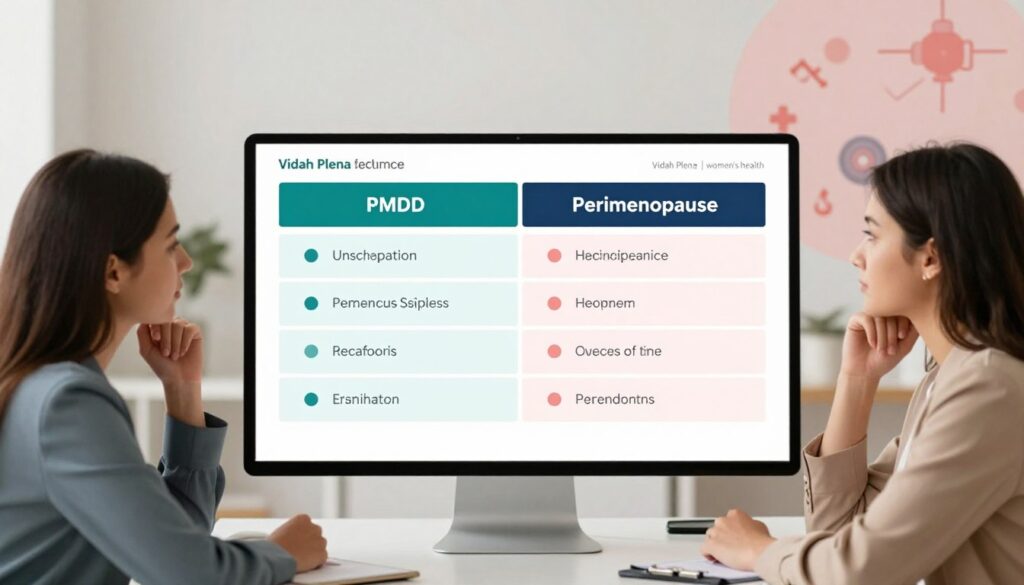
This table helps you see the differences between PMDD and perimenopause. It shows how symptoms like mood changes and physical complaints vary between the two. It’s a useful tool for talking to your doctor.
| Feature | PMDD | Perimenopause |
|---|---|---|
| Timing / pattern | Predictable luteal-phase onset. Symptoms peak before menses and remit within days after flow starts. | Irregular and often unpredictable. Symptoms may occur across cycles or persist without clear cycle link. |
| Mood and affect | Marked irritability, anger, depression, or anxiety that is cyclical and tied to the late luteal phase. | Mood instability can be ongoing. Emotional changes often relate to sleep disruption or hot flashes. |
| Vasomotor symptoms | Uncommon. Hot flashes and night sweats are not typical features tied to PMDD. | Common. Hot flashes, night sweats, and temperature sensitivity frequently occur and disrupt sleep. |
| Menstrual changes | Cycles are usually regular. Timing of symptoms aligns with ovulatory cycles. | Cycles become shorter, longer, heavier, or lighter. Irregular bleeding is a hallmark sign. |
| Cognitive symptoms | Brain fog and concentration problems appear in a cyclical pattern, worse in the luteal phase. | Persistent cognitive complaints are common and may not follow a strict cycle. |
| Physical symptoms | Bloating, breast tenderness, headaches, and joint aches localized to the luteal phase. | Broader systemic signs such as joint pain, palpitations, skin changes, and generalized fatigue occur more steadily. |
| Typical age range | Reproductive-age individuals with regular cycles, often in their 20s to 40s. | Perimenopause usually begins in the 40s but can start earlier or later for some people. |
| Diagnostic approach | Prospective symptom tracking across at least two cycles is essential to confirm luteal-phase patterns. | Menstrual history and hormone evaluation help confirm irregular cycles and menopausal transition. |
Remember, this table is just a guide. It’s not a diagnosis. Always track your symptoms and talk to your doctor to figure out if you have PMDD or perimenopause.
Hormonal Differences Between PMDD and Perimenopause
PMDD and perimenopause can both cause mood swings, but they have different causes. In PMDD, it’s not about always having too much or too little hormone. It’s how the brain reacts to normal hormone levels during the luteal phase.
Research shows that progesterone sensitivity is key in PMDD. After ovulation, the ovary makes progesterone. This leads to a molecule called allopregnanolone, which affects GABA and serotonin. For some, this molecule causes anxiety and irritability instead of calmness.
Perimenopause, on the other hand, has a different pattern. Hormones from the ovaries go up and down as they decrease. This leads to unpredictable cycles and more months without ovulation. Follicle-stimulating hormone (FSH) levels also go up but can change from test to test.
One lab test isn’t enough to diagnose perimenopause. A single FSH or estradiol test might not show the ups and downs of perimenopause. Anti-Müllerian hormone (AMH) can give clues about ovarian reserve, but it’s not enough on its own.
Treatment for PMDD and perimenopause depends on these differences. For PMDD, doctors might use treatments that reduce the effects of luteal-phase hormones or change how neurotransmitters work. This can include certain antidepressants or birth control pills with drospirenone.
For perimenopause, the goal is to stabilize decreasing estrogen levels when it’s safe to do so. Hormone therapy can help with hot flashes and mood swings caused by estrogen changes. Your medical history and future symptoms are key in choosing the right treatment.
| Feature | PMDD | Perimenopause |
|---|---|---|
| Primary hormonal driver | Brain sensitivity to luteal progesterone and allopregnanolone | Erratic ovarian hormone production with overall decline |
| Typical lab pattern | Normal cycle hormones between episodes; no consistent abnormal levels | Variable estradiol and progesterone, often rising FSH over time |
| Role of progesterone sensitivity | Central; triggers mood symptoms via neuroactive metabolites | Less central; changes reflect shifting ovulation and hormone output |
| Diagnostic value of single tests | Limited; diagnosis relies on symptom timing and tracking | Limited; single FSH or estradiol tests may be misleading |
| Common treatment focus | Reduce luteal hormone effects or target neurotransmitters (SSRIs, specific COCs) | Stabilize estrogen and manage vasomotor and menstrual changes (HT when appropriate) |
Anxiety and Depression Symptoms
You might feel mood swings tied to your cycle or a constant low mood. Symptoms of pmdd anxiety and pmdd depression get worse in the luteal phase and get better with your period. You could feel panic, sudden anger, or deep sadness every month.
Anxiety and depression during perimenopause are different. They can cause ongoing distress. Night sweats and broken sleep can make these feelings worse. You might feel anxious all the time, very tired, or numb, without a clear pattern.
Tracking your symptoms can help. PMDD often has a “good week” in the follicular phase. Perimenopause can cause mood changes that don’t follow a pattern. If you had PMDD before, it might come back during perimenopause, making things more complicated.
How you manage these conditions depends on the pattern. For pmdd, SSRIs are often the first choice for quick relief. For perimenopause, treating sleep and hot flashes might help your mood. Hormone therapy might be an option for some.
Both conditions can improve with therapy and lifestyle changes. Cognitive behavioral therapy and regular exercise can help. See this guide for more on depression symptoms and how to diagnose them.
| Feature | PMDD | Perimenopause |
|---|---|---|
| Timing | Predictable luteal-phase spikes | Unpredictable or continuous |
| Anxiety | Intense, short-lived panic or worry (pmdd anxiety) | Persistent worry linked to sleep loss and vasomotor symptoms |
| Depression | Marked premenstrual low mood and anhedonia (pmdd depression) | Sustained low mood, appetite or sleep changes (depression during perimenopause) |
| Treatment focus | SSRIs, luteal-phase interventions, CBT | Sleep and hot-flash management, HRT when appropriate, CBT |
| Symptom resolution | Symptoms remit with menses | May persist beyond cycles |
Sleep Problems and Fatigue

People with PMDD or in perimenopause may face sleep issues. PMDD often causes insomnia or too much sleep in the luteal phase. This problem goes away once your period starts. Afterward, you might feel very tired, low in energy, and sluggish.
Perimenopause brings its own sleep challenges. Night sweats and sleep disruptions are common due to hot flashes. Irregular cycles can lead to chronic or intermittent insomnia. Fatigue in perimenopause can last longer than PMDD’s cycle-based tiredness.
Hot flashes that disrupt sleep all month long suggest perimenopause. If your sleep problems follow your cycle, PMDD might be the cause. Keeping a symptom diary can help track these patterns.
Managing sleep issues depends on the diagnosis. For PMDD, short-term SSRIs and sleep hygiene in the luteal phase can help. In perimenopause, treating hot flashes with hormone therapy or nonhormonal options can improve sleep.
Behavioral strategies are helpful for both conditions. Cognitive behavioral therapy for insomnia, regular sleep routines, and avoiding caffeine can enhance sleep. Exercise, staying hydrated, and prioritizing sleep also help. Working with your doctor to find the right treatment can reduce tiredness and boost energy.
Brain Fog and Cognitive Changes
You might find words hard to remember, tasks take longer, or your focus wanders. Cognitive changes in PMDD often follow a pattern. They start in the luteal phase and get better after your period.
Brain fog in perimenopause, on the other hand, can be more constant. You might forget things, struggle to find words, or have trouble staying focused. These issues can be linked to changing estrogen levels, poor sleep, or hot flashes.
Concentration problems in PMDD usually follow a cycle. They are often tied to mood and hormonal changes. Keeping track of symptoms over several cycles can show if they follow the luteal phase pattern.
If your thinking problems don’t follow a cycle or keep getting worse, it might be perimenopause or another health issue. A pattern tied to menstrual phases suggests PMDD. But if symptoms keep changing or getting worse, it could be perimenopause.
Managing these issues starts with finding the root cause. Treating sleep problems, anxiety, or depression can help with focus. For perimenopause, balancing hormones and managing hot flashes can reduce brain fog.
Everyday strategies can help too. Use lists, timers, and focus on one task at a time. Fixing nutritional gaps, checking your meds with your doctor, and trying brain exercises can help with PMDD or perimenopause-related thinking problems.
How PMDD Is Diagnosed
Understanding how pmdd is diagnosed is key to getting the right care. It involves a detailed clinical review and keeping symptom records. You’ll learn what doctors look for and how tracking symptoms helps make decisions.
Medical Evaluation
In a pmdd medical evaluation, doctors check for other health issues. They look for major depressive disorder, bipolar disorder, thyroid disease, and how medications might affect you.
The visit will cover your menstrual cycle, symptom timing, and how symptoms impact your life. Expect questions about your medication use and family history of mental health issues.
Doctors use specific criteria for diagnosis. They look for at least five symptoms, with one being related to mood. Symptoms must appear in most cycles of the past year, ease after your period, and significantly affect your life.
Symptom Tracking
Tracking symptoms for at least two menstrual cycles is essential for diagnosis. Daily logs track mood changes, physical issues, and menstrual dates to confirm the timing of symptoms.
Use tools like Flo or Clue apps or printable charts for tracking. Record mood swings, irritability, anxiety, depressed mood, physical pain, and sleep changes daily.
Tracking helps guide treatment choices, like SSRI dosing or hormonal suppression. It also helps tell PMDD apart from perimenopause when cycles are regular. Clear records make talking to your doctor more effective and speed up diagnosis.
How Perimenopause Is Diagnosed

Start by looking at your menstrual history. Note any changes in cycle length, flow, or missed periods. Also, track symptoms like hot flashes or mood changes.
Hormone Testing
Hormone tests can help, but be careful with the results. Tests like FSH and estradiol can give clues. But, a single normal FSH doesn’t mean you’re not in perimenopause.
Menstrual History Assessment
Your menstrual history is key. Keep a record of your cycles and symptoms for months. This helps spot patterns and links between symptoms and bleeding.
Doctors also check for other health issues that might look like perimenopause. If it’s hard to tell, you might see a gynecologist or menopause specialist.
| Diagnostic Element | What It Shows | Limitations |
|---|---|---|
| Menstrual history | Changes in cycle length, flow, and pattern tied to symptoms | Requires consistent tracking; irregular cycles can complicate timing |
| FSH and estradiol | Biological signs of ovarian aging and hormone shifts | Values vary day-to-day; single tests can be misleading |
| AMH | Estimate of ovarian reserve that may explain declining function | Not diagnostic for symptom onset or perimenopause timing |
| Symptom tracking | Links mood, sleep, and hot flashes to cycle changes | Needs consistent entries; subjective but clinically valuable |
| Clinical evaluation | Rules out thyroid disease, anemia, and medication effects | May require additional tests or specialist referral |
For more on mood conditions and perimenopause, listen to this podcast: PMDD and Perimenopause: Symptoms, Diagnosis and.
Can PMDD and Perimenopause Occur Together?
Yes, you can have both PMDD and perimenopause at the same time. If you had PMDD before, perimenopause can make your cycles more unpredictable. It can also make your mood swings stronger.
Hormonal changes are the main reason for this. Changes in estrogen and progesterone levels can make your brain more sensitive. This sensitivity can bring back PMDD symptoms or create new ones.
When you have both conditions, your symptoms can mix together. You might feel the usual PMDD lows and also feel anxious, hot, or have trouble sleeping because of perimenopause.
Doctors usually need to use a mix of treatments. They might use SSRIs or ovarian suppression for PMDD symptoms. For perimenopause, they might use estrogen patches to help with mood and hot flashes.
It’s important to keep track of your symptoms. Write down when they happen, how bad they are, and what triggers them. Share this information with a doctor who knows about reproductive psychiatry or menopause medicine.
| Issue | Typical PMDD Pattern | Typical Perimenopause Pattern | Implication when Co-occurrence pmdd perimenopause |
|---|---|---|---|
| Timing | Luteal phase, cyclic | Irregular cycles, unpredictable | Mixed timing with both cyclic peaks and baseline shifts |
| Hormonal driver | Progesterone sensitivity | Estrogen fluctuation and decline | Amplified CNS response to both hormones |
| Main symptoms | Irritability, mood swings, bloating | Hot flashes, sleep loss, cognitive change | Overlap: mood instability plus vasomotor and sleep issues |
| Diagnostic focus | Symptom tracking through cycles | Hormone tests and menstrual history | Combined tracking and selective hormone testing |
| Treatment examples | SSRIs, luteal suppression | Hormone therapy, lifestyle measures | Integrated plan: psychotropic plus menopausal therapies |
| Care team | Psychiatry, gynecology | Menopause specialists, primary care | Collaborative care with reproductive psychiatry or menopause medicine |
Work closely with your doctor to adjust your treatment plan as needed. Personalized care and keeping detailed records can help manage both conditions better.
Treatment Options for PMDD
You have several evidence-based treatment options for PMDD. SSRIs are the first choice for managing mood, irritability, and anxiety during the luteal phase. They are the most studied and effective medicines.
SSRI dosing can vary. It can be daily, only during the luteal phase, or started when symptoms begin. Your doctor will help decide the best dosage and watch for side effects. Sertraline, fluoxetine, and escitalopram are common choices because of their proven success in studies.
Hormonal therapy is also an option. It helps when hormone swings cause symptoms. Combined oral contraceptives that stop ovulation often reduce symptoms. Drospirenone-containing brands like Yaz have strong evidence backing them.
Supplements and lifestyle changes can also help. Regular exercise, good sleep, staying hydrated, and eating complex carbs in the luteal phase can ease symptoms. Always talk to your doctor before trying supplements like calcium, magnesium, and zinc.
If first-line treatments don’t work, there are other options. GnRH agonists like leuprolide (Lupron) can stop symptoms by causing temporary medical menopause. But, they require careful hormone add-back and can have serious side effects.
Surgical options like hysterectomy with bilateral oophorectomy are rare and permanent. They need careful consideration and discussion about the effects of induced menopause and the need for hormone replacement therapy.
Nonpharmacologic care is important too. Cognitive behavioral therapy can help manage mood symptoms and teach coping skills. Getting help from specialists in reproductive psychiatry or gynecology can help tailor your long-term care.
| Approach | Typical Use | Pros | Cons |
|---|---|---|---|
| SSRIs for PMDD | First-line for mood and anxiety symptoms | Fast relief, flexible dosing strategies, strong evidence base | Side effects like nausea, sleep changes, sexual side effects |
| Drospirenone PMDD (combined OCP) | When ovulation suppression is desired | Reduces luteal symptoms, oral option, proven in trials | Contraindicated with some medical conditions, thrombotic risk |
| PMDD supplements & lifestyle | Adjunctive support for mild to moderate symptoms | Low risk, supports overall health, accessible | Variable evidence strength, interactions possible |
| GnRH agonists / Surgery | Refractory cases after other options tried | Can control severe, treatment-resistant symptoms | Significant side effects, need for add-back therapy or HRT |
| Cognitive Behavioral Therapy | Adjunct or alternative when medication is not preferred | Builds coping skills, durable benefit for mood | Requires access to trained therapists, time commitment |
Discuss risks, benefits, and personal priorities with your doctor. A personalized plan often includes medication, hormonal strategies, lifestyle changes, and therapy. This combination gives you the best chance at symptom relief.
Treatment Options for Perimenopause

First, you need a thorough medical check-up. For many, hormone therapy helps a lot with symptoms like irregular periods and hot flashes. Your doctor will look at your age, health, and when you started perimenopause to see if hormone therapy is right for you.
If hormone therapy isn’t right for you, or if you’d like to try something else, there are other good choices. Medications like SSRIs and SNRIs can help with hot flashes and mood swings. Gabapentin and clonidine are also options for treating hot flashes without hormones.
Improving sleep and managing hot flashes can also help with mood. Start with good sleep habits, regular exercise, and ways to reduce stress. If mood issues don’t get better, talking to a therapist can be very helpful.
Eating right and taking supplements can also help your health. Make sure you get enough calcium and vitamin D for strong bones. Magnesium and zinc might also help with symptoms. Adjust your diet and exercise based on how you’re feeling and what your doctor says.
If your symptoms are really bad or not getting better, ask your doctor for a referral to a specialist. Tests like AMH or FSH can help in tricky cases, but they need careful interpretation.
| Goal | Typical Options | Notes |
|---|---|---|
| Reduce hot flashes | Hormone therapy perimenopause; SSRIs/SNRIs; gabapentin; clonidine | Hormone therapy gives fastest relief when appropriate; nonhormonal meds help if hormones are contraindicated |
| Improve mood | Perimenopause mood treatment with SSRIs/SNRIs; psychotherapy; sleep optimization | Treat sleep and vasomotor symptoms first; combine medication and therapy when needed |
| Fix sleep problems | Sleep hygiene; CBT for insomnia; treat night sweats with hormone or nonhormonal options | Addressing night sweats often improves sleep quality and daytime function |
| Support bone health | Calcium; vitamin D; lifestyle exercise; consider hormone therapy if indicated | Bone prevention is a long-term priority during perimenopause |
| When to see a specialist | Persistent severe symptoms; unclear diagnosis; complex medical history | Referral to a menopause specialist or gynecologist helps tailor treatment perimenopause plans |
Evidence Summary: What Research Shows
Research on PMDD and perimenopause is growing. It helps us understand treatment options and what we can’t diagnose yet. Studies show that selective serotonin reuptake inhibitors (SSRIs) help with PMDD symptoms. They find that different dosing times can reduce symptoms for many people.
Clinical trials also look into how often to take SSRIs. A recent study found that taking them only when symptoms appear can help. This approach can reduce side effects while keeping symptoms under control.
There’s also evidence for combined oral contraceptives, like those with drospirenone. Studies show that these pills can help with mood swings by stopping ovulation. This can be a good option for some patients.
Research on perimenopause focuses on the ups and downs of hormone levels. Hormone therapy is often the best choice for hot flashes and sleep problems. It can also improve quality of life for the right people.
But, hormone tests alone aren’t reliable. Hormone levels change daily. Doctors now look at symptoms and track them over time instead of just testing hormone levels.
For severe PMDD, there are more options. Gonadotropin-releasing hormone agonists can stop ovarian function and control symptoms. But, they cause low estrogen levels and need add-back therapy. Surgery is rare and only for extreme cases because it’s permanent.
There are professional groups that offer guidance and help find doctors. The International Association for Premenstrual Disorders, the International Society of Reproductive Psychiatry, and The Menopause Society are good resources.
| Intervention | Evidence Strength | Key Notes |
|---|---|---|
| SSRIs (continuous, luteal, symptom-onset) | High | Randomized trials and meta-analyses show consistent benefit for mood and irritability; intermittent dosing supported by recent trials. |
| Combined oral contraceptives with drospirenone | Moderate | Drospirenone studies show symptom reduction for some users through ovulation suppression; formulation matters. |
| Hormone therapy for perimenopause | High for vasomotor symptoms | Effective for hot flashes and sleep; must be individualized based on risks and timing. |
| GnRH agonists | Moderate to low (specialty use) | Effective for refractory cases; requires add-back therapy and expert follow-up. |
| Surgical ovarian suppression | Low (last resort) | Produces durable symptom control but with permanent reproductive and hormonal consequences. |
When looking at studies, consider the design, what they measured, and who was in the study. Many studies focus on women of childbearing age. But, perimenopause studies have different ages and hormone levels. Combining findings helps choose the best treatment.
Use studies on SSRIs and drospirenone as part of a bigger plan. This plan should include tracking symptoms, menstrual history, and making decisions together. This approach matches research with real-life care and acknowledges the limits of hormone tests.
Real-World Case Examples
Case 1: A woman in her early 30s had regular 28-day cycles. She experienced severe irritability, crying, and trouble concentrating during her luteal phase. These symptoms went away quickly after her period started. A doctor confirmed she had PMDD based on her symptoms.
She started tracking her symptoms daily. The doctor also suggested an SSRI in the luteal phase. If needed, they could switch to continuous dosing.
They planned to meet weekly for six weeks, then monthly. After four weeks, her mood swings and concentration improved. These improvements lasted at the three-month check-up.
Case 2: A woman in her late 40s noticed irregular cycles and new symptoms like hot flashes and fatigue. Hormone tests showed she was in perimenopause. The doctor focused on her cycle history and symptoms to diagnose her.
The doctor suggested improving sleep and possibly cognitive-behavioral therapy for insomnia. They also discussed menopausal hormone therapy. The woman kept a monthly symptom log and had follow-up FSH tests.
After three months, her hot flashes and fatigue improved. This was thanks to tailored therapy and sleep interventions.
Case 3: A woman in her late 40s with a history of PMDD noticed her symptoms worsening. She had more mood swings, irregular cycles, and hot flashes. The doctor recommended tracking her symptoms and hormone testing.
The doctor suggested continuing her SSRI and exploring hormonal treatments. They planned to track her symptoms and mood. They also coordinated care with a menopause specialist.
After a while, her symptoms became clearer. The combination of treatments helped manage her mood and hot flashes.
Below is a concise comparison of the three real cases to help you see practical differences in assessment, treatment, and follow-up.
| Feature | PMDD Classic (Case 1) | Perimenopause Classic (Case 2) | Co-occurrence (Case 3) |
|---|---|---|---|
| Age | Early 30s | Late 40s | Late 40s |
| Cycle Pattern | Regular 28-day cycles, luteal symptoms | Increasingly irregular cycles | Irregular cycles with prior PMDD history |
| Primary Symptoms | Irritability, crying spells, concentration problems | Hot flashes, night sweats, fatigue, noncyclical mood swings | Worsening mood variability, intermittent hot flashes |
| Key Tests | Prospective symptom diary, clinical DSM criteria | FSH trends, menstrual history | Symptom tracking, selective hormone testing |
| Treatment Approach | Luteal-phase or continuous SSRI, tracking | Menopausal hormone therapy discussion, sleep/vasomotor management | Combination of SSRI and hormonal strategies, specialist referral |
| Monitoring Plan | Weekly then monthly reviews, symptom diary | Monthly logs, sleep assessment, follow-up FSH as needed | Coordinated care, mood scales, ongoing tracking |
| Typical Outcome | Rapid symptom improvement on SSRI within weeks | Reduced vasomotor symptoms and better daytime energy | Improved mood stability with combined therapy |
These pmdd case examples, perimenopause case scenarios, and women-specific case studies highlight the importance of personalized care. Use symptom tracking and targeted testing to guide treatment. This helps decide when to refer a patient to a specialist.
When to Seek Medical Help
If you feel overwhelmed or have constant thoughts of suicide, call 911 or the U.S. 988 Suicide & Crisis Lifeline right away. These are signs that need quick help from emergency or crisis services.
For less urgent issues, schedule a doctor’s visit if symptoms affect your work, relationships, or daily life. Also, seek help if mood and anxiety problems get worse. If you’re in your 30s–50s and notice irregular cycles, hot flashes, or brain fog, it’s time to see a doctor.
Take notes on your symptoms for at least two months before your visit. Write down your mood, physical symptoms, bleeding, sleep, medications, and menstrual history. This information helps doctors diagnose and choose the right treatment, like SSRIs or hormone therapy. For complex cases, consider seeing a reproductive psychiatrist or menopause specialist.
Tracking your symptoms early and talking to a doctor can greatly improve your health. For tools on anxiety and knowing when to seek more help, check out this checklist and more on Vidah Plena. If you need immediate mental health support, call 988 or 911 without delay.
FAQ
What is the main difference between PMDD and perimenopause?
PMDD is a severe mood and physical symptom syndrome that starts before your period and goes away with it. Perimenopause is a long transition before menopause with unpredictable symptoms and cycle changes.
How can I tell whether my mood swings are PMDD or perimenopause?
Look at the timing and pattern of your symptoms. If they worsen before your period and improve afterward, it might be PMDD. If your mood changes are constant and not tied to your cycle, it could be perimenopause. Tracking your symptoms for two cycles helps figure out the pattern.
What symptoms overlap between PMDD and perimenopause?
Both can cause mood swings, anxiety, and depression-like feelings. They also lead to fatigue, brain fog, and sleep problems. Look for hot flashes and cycle changes to point to perimenopause. A consistent pattern before your period suggests PMDD.
Are hot flashes and night sweats more typical of perimenopause or PMDD?
Hot flashes and night sweats are common in perimenopause but rare in PMDD. If you have these symptoms, it’s likely perimenopause, even with irregular cycles.
Can PMDD and perimenopause happen at the same time?
Yes. Women with PMDD may see their symptoms worsen during perimenopause. This is because hormonal changes can make symptoms worse. Treatment needs to address both conditions.
What diagnostic tools are most useful for distinguishing these conditions?
Daily symptom tracking for two cycles is key. For PMDD, look for specific symptoms that follow a pattern. Hormone tests can help but are not as important as symptom history.
What are the 11 PMDD diagnostic symptoms I should track?
Track symptoms like depressed mood, anxiety, mood swings, and physical issues. Also, watch for changes in appetite, sleep, and feeling overwhelmed. These symptoms help diagnose PMDD.
Which medications work best for PMDD?
SSRIs are the most effective treatment for PMDD. You can take them continuously or just during the luteal phase. Lifestyle changes and supplements like zinc can also help. For severe cases, consider GnRH agonists or surgery.
What treatment options are typical for perimenopause-related mood and vasomotor symptoms?
Menopausal hormone therapy (HT) can help with hot flashes and mood. Nonhormonal options include SSRIs and gabapentin. Improving sleep and using supplements like calcium are also important.
How helpful are blood tests (FSH, estradiol, AMH) in diagnosing perimenopause?
Blood tests are not very accurate for diagnosing perimenopause. Hormone levels change too much. Your symptoms and cycle history are more telling.
What should I bring to a medical appointment when I suspect PMDD or perimenopause?
Bring two months of symptom tracking and a detailed menstrual history. Include your medications, sleep patterns, and how symptoms affect you. This helps doctors make the right diagnosis and treatment plan.
When should I seek immediate help?
Call 911 or the U.S. 988 Suicide & Crisis Lifeline if you have suicidal thoughts or feel in danger. It’s a mental health emergency.
Can lifestyle changes and supplements help with PMDD or perimenopause?
Yes. Regular exercise, good sleep, and stress reduction help both conditions. Supplements like zinc and calcium can also be beneficial. Always talk to your doctor before starting any supplements.
What are practical next steps if tracking suggests PMDD or perimenopause?
Continue tracking symptoms and discuss them with a doctor. Start treatments like SSRIs or hormone therapy based on your diagnosis. Consider therapy like CBT. For more help, see specialists at organizations like the International Society of Reproductive Psychiatry.
Where can I find reliable resources and further reading?
Check out organizations like the International Association for Premenstrual Disorders and The Menopause Society. Vidah Plena offers resources on PMDD, nutrition, and supplements for women’s mental health.