

You wake up some months feeling like a different person. You might feel anxious, tearful, or angry. These feelings often go away after your period. Or, you might notice mood swings and memory lapses at any time.
This confusion and frustration is common. It makes you wonder: am I dealing with PMDD or perimenopause?
Short answer: the difference matters because it changes diagnosis and treatment. PMDD is a severe form of premenstrual syndrome. It has emotional and physical symptoms that appear in the luteal phase and go away soon after menses.
Perimenopause is the transition before menopause. It’s when ovarian function becomes erratic. This leads to irregular cycles and symptoms that can occur at any point in the cycle and last beyond menstruation.
This question matters for your daily life and long-term health. PMDD diagnosis guides treatments like SSRIs or combined oral contraceptives. Perimenopause diagnosis may point to hormone therapy, nonhormonal options, or lifestyle measures.
The latest research shows that fluctuating estrogen affects serotonin, dopamine, and stress response systems. This explains why mood, cognition, and sleep change during both PMDD and perimenopause. Studies also emphasize the need for tracking symptoms across at least two cycles and a careful medical evaluation.
This article is evidence-based and clinically informed. It was reviewed by Dr. Helloyze Ferreira Ancelmo (CRM-GO 31293). It will walk you through a Quick Answer, clear Key Takeaways, a symptom comparison table, and how doctors differentiate PMDD and perimenopause.
You’ll also find practical examples, actionable steps, and notes on risks and limitations. For more on how hormonal shifts affect mood and broader mental health in midlife, see this resource on menopause and mental health from VidaH Plena: menopause and mental health.
Key Takeaways
- PMDD causes severe, cyclic symptoms tied to the luteal phase and clears quickly after menses; perimenopause causes variable, often persistent symptoms across the cycle.
- How to know if I have pmdd or perimenopause: symptom timing, age, and consistent tracking are essential for clarification.
- PMDD diagnosis relies on prospective symptom tracking and diagnostic criteria; perimenopause diagnosis includes clinical history and may use lab tests cautiously.
- Treatments differ: SSRIs and certain combined oral contraceptives help PMDD, while hormone therapy and lifestyle strategies help many perimenopausal symptoms.
- Because falling estrogen affects mood, memory, and sleep, both conditions can overlap—working with a clinician avoids missed or delayed care.
Quick Answer
If your mood swings follow a pattern, starting in the luteal phase and easing after your period, you might have PMDD. Watch for this pattern for two to three cycles to be sure.
But, if your symptoms are unpredictable and happen at any time, or if they last after your period, you might be going through perimenopause. This condition often starts between 35 and 45 years old, while PMDD can happen at any reproductive age.
It’s possible for both conditions to happen at the same time. This makes it hard to tell if you have PMDD or perimenopause without tracking your symptoms closely and getting help from a doctor.
Here’s what you can do first: start tracking your symptoms and cycles every day. Note how your mood swings and hormones affect your sleep and energy. If your symptoms are really affecting your work or relationships, talk to a doctor. The treatments for PMDD and perimenopause are different, too.
For a quick guide on PMDD and perimenopause, check out this summary from Hone Health: PMDD and perimenopause overview.
| Feature | PMDD | Perimenopause |
|---|---|---|
| Timing | Consistent luteal-phase symptoms, resolve after start of bleeding | Variable timing; symptoms can occur anytime and persist beyond menses |
| Typical age | Can occur across reproductive years (often 20s–40s) | Most common onset 35–45, can start earlier |
| Common emotional signs | Severe mood swings, irritability, anxiety, hopelessness | Mood swings, anxiety, low mood linked to erratic hormones |
| Diagnosis tip | Daily tracking showing cyclical pattern for ≥2 cycles | Irregular cycles and persistent symptoms; hormone testing and history |
| Treatment examples | SSRIs, drospirenone-containing pills, lifestyle changes | HRT under supervision, lifestyle and nutritional strategies |
Key Takeaways
When looking at pmdd diagnosis versus perimenopause, timing is key. If symptoms follow a predictable pattern in the luteal phase and go away with your period, PMDD might be the cause. But if symptoms are unpredictable or last all month, think about perimenopause.
For a PMDD diagnosis, symptoms must follow a pattern. You need at least five of eleven key symptoms in most cycles for 12 months. One of these must be a mood symptom. Symptoms should go away once your period starts. Keeping a daily log can help track these symptoms.
Perimenopause is about a gradual change in cycles and hormones. Symptoms can happen at any time due to changing estrogen and early progesterone decline. While lab tests like FSH can help, they’re not always reliable during this time.
Tools for diagnosis include tracking symptoms for 2–3 months and a detailed medical history. You can use apps or paper charts to record mood, sleep, appetite, and physical signs. This helps build a clearer picture of your symptoms.
For PMDD, the best treatments are SSRIs and certain birth control pills like Yaz. Lifestyle changes and supplements like magnesium, calcium, and zinc can also help.
Perimenopause care focuses on managing irregular cycles and symptoms. Hormone therapy might be right for many. Eating well, getting enough sleep, and exercising regularly can also help manage symptoms.
If symptoms are severe or include thoughts of suicide, get help right away. Call 988 or 911 in the U.S. Early help from a specialist can make a big difference.
For reliable information and support, check out the International Association for Premenstrual Disorders and The Menopause Society. For tips on managing symptoms and mental health, see this guide: TPM health and mental wellness.
| Focus | Typical Timing | Key Diagnostic Steps | Common First-Line Options |
|---|---|---|---|
| PMDD | Predictable luteal-phase symptoms, remit with menses | Daily symptom diary 2–3 months; structured history; rule out mood disorders | SSRIs (luteal or continuous), combined OCP with drospirenone, lifestyle, magnesium |
| Perimenopause | Unpredictable timing; symptoms any time; cycles irregular | Clinical history, symptom tracking, selective labs (FSH limited); consider endocrine review | Hormone therapy when appropriate, sleep and nutrition strategies, exercise, calcium/vitamin D |
| Shared features | Emotional and physical overlap across the month | Careful timeline mapping to distinguish patterns | Behavioral interventions, targeted supplements, specialist referral when severe |
Why These Conditions Are Often Confused
Many people confuse PMDD and perimenopause because their symptoms are similar. Mood swings, irritability, sleep loss, and fatigue can happen in both. It’s hard to tell if symptoms are from PMDD or perimenopause.
Shared Symptoms
Both conditions can cause anxiety, depression, and physical issues like breast tenderness and bloating. You might feel tired or have trouble sleeping before your period. These symptoms can make it hard to know if you have PMDD or perimenopause.
Tracking your symptoms can help. You might see a pattern of worsening mood before your period. Or, you might notice symptoms that don’t follow a monthly pattern and last longer.
Hormonal Overlap
Hormones like estrogen and progesterone affect mood. Estrogen and serotonin work together, while progesterone and GABA have a connection. Changes in these hormones can cause similar symptoms in both PMDD and perimenopause.
In PMDD, the rise in progesterone can cause anxiety instead of calm. In perimenopause, ovulation becomes irregular, leading to fewer periods of progesterone and more estrogen swings. This can make symptoms seem like PMDD.
| Feature | PMDD Pattern | Perimenopause Pattern |
|---|---|---|
| Timing | Predictable luteal-phase onset, clears by day 7 of menses | Unpredictable timing, symptoms may persist across cycles |
| Mood profile | Marked mood swings and irritability tied to cycle | Chronic mood instability with intermittent worsening |
| Hormones involved | Progesterone changes and allopregnanolone sensitivity | Estrogen changes plus declining or erratic progesterone |
| Physical signs | Bloating, breast tenderness, sleep changes premenstrually | Vasomotor symptoms, variable cycle length, sleep disruption |
| Clinical clue | Symptoms reliably start before menses | Symptoms lack clear premenstrual pattern or worsen over years |
Signs You May Have PMDD
Wondering if you have PMDD or perimenopause? Look at how symptoms show up and when. PMDD symptoms often follow a pattern each month. Keeping a symptom journal helps you and your doctor figure out what’s going on.

Getting a PMDD diagnosis means you have to show a group of symptoms that get worse before your period and get better soon after. See if your symptoms match the luteal phase. Also, think about how they affect your daily life and relationships.
Emotional Symptoms
You might feel really down or overwhelmed. Women often experience anxiety and depression. Mood swings or feeling very sad can happen suddenly.
Feeling angry or irritable can lead to fights with others. Losing interest in things you usually enjoy is common too.
Other signs include trouble focusing and feeling like you’re losing control. For a PMDD diagnosis, you need at least one mood symptom. You also need to have five or more symptoms in total.
Physical Symptoms
Physical symptoms often go hand in hand with emotional ones. You might feel breast tenderness or swelling, or have pain in your joints or muscles. Headaches, bloating, changes in appetite, or sleep problems like insomnia or too much sleep are also common.
These physical symptoms are part of the diagnosis if they happen before your period. But, if you have severe or ongoing symptoms like hot flashes or irregular periods, it might be perimenopause or something else.
Symptom Timing
When symptoms happen is key. PMDD symptoms usually start in the luteal phase, just before your period, and get better soon after. This pattern should happen in most of your cycles over the past year.
To confirm PMDD, doctors want you to track your symptoms daily for at least two months. If symptoms last longer than your period or happen at different times, it might not be PMDD. Talk to your doctor about other possibilities like perimenopause.
| Feature | Typical PMDD Pattern | When to Suspect Perimenopause |
|---|---|---|
| Symptom timing | Starts in luteal phase, resolves within 1–2 days of menses | Symptoms persist across cycle phases or vary unpredictably |
| Emotional profile | Depressed mood, anxiety and depression in women, mood swings, irritability | Low mood or anxiety without clear cyclical pattern |
| Physical signs | Bloating, breast tenderness, headache, sleep and appetite changes | Hot flashes, night sweats, marked menstrual cycle changes |
| Functional impact | Significant impairment at work, school, or in relationships during luteal phase | Gradual decline in functioning not tied to premenstrual timing |
| Diagnosis approach | Prospective daily tracking, at least two months; clinical review of 12 months | Hormone testing, assessment of menstrual cycle changes and age-related signs |
Signs You May Be Entering Perimenopause
Tracking your body can reveal signs of perimenopause, not just mood swings. Look for patterns over months, not just weeks. Keeping a log of menstrual cycle changes and symptoms is key for diagnosing perimenopause and figuring out if you have PMDD or perimenopause.
Cycle Changes
Your periods might get shorter or longer, heavier or lighter. You might even skip a cycle now and then. As ovulation becomes less regular, progesterone drops early, making symptoms worse before they’re obvious.
Big changes in cycle timing, flow, or bleeding are stronger signs of perimenopause than PMDD. Keeping a record helps doctors diagnose perimenopause and supports mental health care.
Vasomotor Symptoms
Hot flashes and night sweats are signs of estrogen changes. These symptoms might start mild but become more noticeable. If you notice new hot flashes or night sweats outside of the premenstrual week, it could be perimenopause.
Look for vaginal dryness, sexual discomfort, and joint aches too. These symptoms, along with hot flashes, often point to perimenopause over PMDD.
Age Considerations
Perimenopause usually starts between the mid-30s and mid-40s. But it can start earlier for some. PMDD can happen at any age, so age alone isn’t enough to confirm perimenopause.
If you’re in your late 30s or 40s and your PMS symptoms worsen, consider perimenopause. Tracking changes for one to two years is the best way to confirm a perimenopause diagnosis and understand if you have PMDD or perimenopause.
| Feature | Typical Perimenopause Pattern | Typical PMDD Pattern |
|---|---|---|
| Menstrual cycle changes | Shortened or lengthened cycles, skipped periods, heavier or lighter flow over months | Cycles often remain regular; symptoms align with luteal phase |
| Timing of mood/physical symptoms | Symptoms may be continuous or vary unpredictably across the month | Symptoms occur in the week before menses and remit after bleeding starts |
| Vasomotor symptoms | Hot flashes and night sweats common, reflect estrogen fluctuation | Uncommon; hot flashes not typical as primary sign |
| Hormonal pattern | Irregular ovulation and declining progesterone early; estrogen fluctuation | Normal ovulatory patterns often preserved; cyclic sensitivity to hormones |
| Age range | Most start mid-30s to mid-40s but can vary | Can occur at any reproductive age |
| Implications for care | Perimenopause diagnosis may lead to hormone-focused treatments and symptom management | Treatments focus on luteal-phase symptom control and reproductive mental health strategies |
Symptom Comparison Table
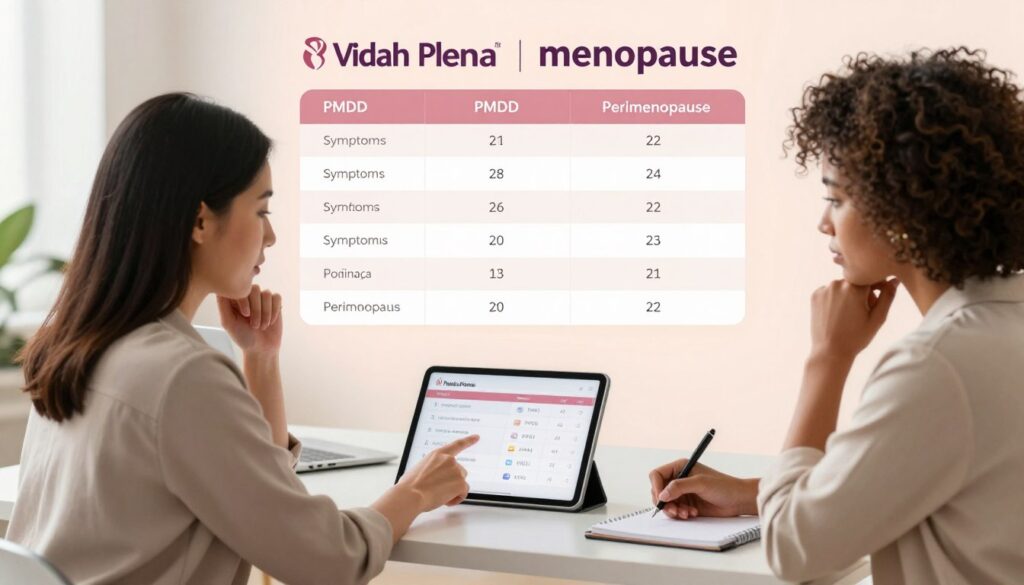
| Feature | PMDD | Perimenopause |
|---|---|---|
| Timing | Symptoms appear in the luteal phase and go away with menses. | Symptoms can happen at any time in the cycle and are less predictable. |
| Symptom persistence | Usually goes away with the start of your period; symptoms often clear up. | May last longer than menses and can last weeks to months; symptoms can be ongoing. |
| Cycle pattern | Has regular cycles; pattern helps diagnose PMS vs perimenopause. | Has irregular cycles and anovulation as ovarian function changes. |
| Specific symptoms | Has marked mood swings, irritability, severe functional impairment, and food cravings. | Has vasomotor symptoms, vaginal dryness, sleep disruption, and joint aches. |
| Age & onset | Occurs in reproductive years and may be longstanding; consider history of cyclical mood issues. | Often starts in mid-30s to 40s with a recent change in cycle or symptom pattern. |
| Diagnostic tools | Uses prospective daily tracking and DSM criteria for diagnosis; symptom comparison with tracked charts is key. | Uses clinical history, cycle tracking, and limited-value labs like FSH for assessment. |
| Management direction | Treatments focus on mood stabilization, SSRIs, lifestyle, and targeted supplements. | Treatments aim to relieve vasomotor symptoms, hormonal strategies, vaginal health, and nutrition. |
| Overlap and co-occurrence | Overlap with perimenopause can occur; you may have both conditions. | Overlap with PMDD is common; individualized assessment is needed for PMS vs perimenopause decisions. |
This symptom comparison can help guide discussions with your clinician and plan for prospective tracking. For more information, explore Vidah Plena content on PMDD, supplements, nutrition, hormonal health, and women’s mental health. This will help deepen your understanding of pmdd or perimenopause and the differences between PMS vs perimenopause.
Hormonal Changes Explained
Understanding hormone shifts helps you tell apart cyclic mood swings from longer-term changes. Estrogen and progesterone move through predictable patterns during your cycle. These patterns can alter mood, sleep, and temperature regulation. Tracking symptoms gives clearer context for any perimenopause diagnosis or PMDD concerns.
Estrogen physiology and fluctuation
Estrogen changes across the menstrual cycle. Levels rise in the follicular phase, peak at ovulation, then fall and stabilize in the luteal phase. Estrogen binds receptors in the brain to support mood, cognition, sleep quality, and temperature control. Fluctuation, not simply low levels, drives many early perimenopausal symptoms.
In PMDD, estrogen tends to drop before menstruation as part of the normal cycle. That drop interacts with progesterone and serotonin systems and can trigger luteal phase symptoms. In perimenopause, estrogen is more erratic: cycle-to-cycle swings create unpredictable symptoms and common vasomotor features.
Progesterone dynamics and downstream effects
Progesterone rises after ovulation during the luteal phase. Your body metabolizes it to allopregnanolone, a neuroactive steroid that acts on GABA receptors to influence calm and sleep. Normal rises in progesterone can be soothing for many women.
Some people with PMDD show increased sensitivity to normal progesterone and allopregnanolone shifts. Instead of calming, these changes can cause anxiety, irritability, and mood destabilization in the luteal phase. In perimenopause, fewer ovulatory cycles lower overall progesterone, which can create a relative estrogen dominance early on and worsen premenstrual-like symptoms before cycles become irregular.
| Hormone | Typical cycle pattern | Role in mood & symptoms | Relevance to PMDD | Relevance to Perimenopause |
|---|---|---|---|---|
| Estrogen | Rises then peaks at ovulation; fluctuates across cycles | Supports mood, cognition, sleep, temperature via CNS receptors | Pre-menstrual drops can worsen luteal phase symptoms | Erratic swings cause unpredictable symptoms; key in perimenopause diagnosis |
| Progesterone | Rises after ovulation in the luteal phase | Stabilizes mood in many; converts to allopregnanolone | Sensitivity to normal changes can trigger anxiety and irritability | Declines as ovulation becomes less frequent, leading to relative estrogen dominance |
| Allopregnanolone | Produced from progesterone in luteal phase | Modulates GABA receptors; affects calm and sleep | Paradoxical effects in sensitive individuals can worsen mood | Lower production with fewer ovulations may reduce GABAergic tone |
| Clinical approaches | N/A | N/A | SSRIs and hormonal suppression (combined contraceptives, GnRH analogues) show benefit for select patients | Treatment focuses on symptom control and confirming perimenopause diagnosis through history and testing |
How Doctors Differentiate PMDD and Perimenopause
When you visit a doctor for mood and cycle changes, they start by reviewing your medical history. They ask about your menstrual patterns, any mental health issues, and what medications you’re taking. They also want to know about surgeries and pregnancies.

Keeping a daily log of your symptoms is key. For at least 2–3 months, note your mood, anxiety, sleep, and physical symptoms. This helps show if your symptoms follow a specific cycle pattern.
Doctors look for patterns to decide between PMDD and perimenopause. PMDD symptoms must match the luteal phase and interfere with daily life. Perimenopause symptoms can be irregular and happen at any time in the cycle.
Lab tests help but are not definitive. Doctors might talk about FSH tests but note their limitations. Other tests can check for thyroid issues or anemia.
Seeing specialists can help if your symptoms are complex. You might see a reproductive psychiatrist or a menopause specialist. Your primary care doctor can help coordinate care and understand your symptoms.
The diagnosis process uses formal criteria and the doctor’s judgment. PMDD is diagnosed based on specific symptoms and timing. Rarely, more tests are needed if there are red flags.
| Assessment Step | What You Provide | What Clinician Looks For |
|---|---|---|
| Medical history | Menstrual dates, psychiatric history, meds, surgeries | Onset, pattern, other psychiatric explanations, surgical causes |
| Symptom tracking | Daily logs for 2–3 months, luteal phase tracking, app or paper forms | Consistent luteal timing for pmdd diagnosis vs. irregular timing for perimenopause diagnosis |
| Laboratory tests | FSH, TSH, CBC, metabolic panel | Rule out alternative causes; interpret FSH with caution due to FSH testing limitations |
| Specialist referral | Complex symptoms, treatment resistance, diagnostic uncertainty | Reproductive psychiatry, gynecology, menopause expertise for targeted management |
Treatment Considerations
Choosing the right therapy depends on your symptoms, medical history, and what you want for your future. Many treatments for mood and cycle issues are similar. Your doctor will pick the best option for you.
PMDD treatment options
For PMDD, antidepressants are often the first choice. SSRIs are the most studied and may be taken all the time, just during the luteal phase, or when symptoms start. Your doctor will decide the best timing and type for you.
Birth control pills can also help by stopping ovulation. Some pills, like those with drospirenone, have shown promise in studies. But how well they work can vary from person to person.
Other options include hormone treatments like transdermal estradiol with progestogen or short-term GnRH agonists. These need careful monitoring and might require add-back therapy. Surgery is a last resort with serious long-term effects.
There are also other treatments being explored. Dutasteride and selective progesterone receptor modulators are being looked at for their effects on hormones. Newer drugs that target allopregnanolone have shown promise but are limited by supply or development issues. For more information, see this review.
Lifestyle changes can also help manage symptoms. Regular exercise, good sleep habits, and eating well can reduce mood swings. Supplements like calcium, magnesium, and zinc might also help. Always talk to a doctor before starting any new treatments, including antidepressants or hormonal therapies.
Perimenopause treatment options
Hormone therapy can help with hot flashes and sleep problems. If you have a uterus, you’ll also need progestogen to protect it. It’s important to weigh the benefits and risks based on your health and age.
For those who can’t take hormone therapy, SSRIs and SNRIs can help with mood and hot flashes. Gabapentin or clonidine might be options too.
Good nutrition is key during perimenopause. Focus on protein, calcium, vitamin D, and fiber. Adding magnesium and B vitamins can help with mood and sleep. Exercise, not smoking, and managing weight are also important for bone health as estrogen levels drop.
If you’re experiencing heavy bleeding or severe hot flashes, see a specialist. They can discuss further treatment options and long-term plans with you.
| Goal | Common options | Notes |
|---|---|---|
| Reduce luteal mood symptoms | SSRIs for PMDD; drospirenone birth control | SSRI schedules vary; contraceptive benefit depends on formulation |
| Control hot flashes | Hormone therapy; gabapentin; SSRIs/SNRIs | Estrogen most effective; nonhormonal drugs help when hormones contraindicated |
| Stabilize hormones | GnRH agonists; transdermal estradiol with progestogen | Used for refractory cases; requires monitoring and possible add-back therapy |
| Supportive care | Nutrition for perimenopause; exercise; sleep hygiene; supplements | Targets sleep, energy, bone health, and mood; discuss supplements with clinician |
When to Seek Medical Help

If you have thoughts of suicide, severe depression, or a mental health crisis, call 988 or 911 in the United States right away. These signs are urgent and need immediate care.
Reach out for prompt evaluation when symptoms seriously affect your job, relationships, or daily tasks. New, severe, or rapidly worsening mood changes mean you should see a clinician sooner than later.
Seek medical advice if your menstrual cycles become markedly irregular, if you have very heavy bleeding, or any abnormal uterine bleeding. Intense hot flashes or night sweats that disrupt sleep also justify a visit.
If you try over-the-counter remedies and lifestyle steps but struggle, schedule an appointment. Persistent symptoms that resist self-care often need tailored treatment and testing to tell pmdd or perimenopause apart.
Before the visit, bring 2–3 months of daily symptom and cycle tracking, a list of medications and supplements, prior psychiatric history, menstrual history, and specific examples of symptoms with timing and triggers. This information makes assessment quicker and more accurate.
Consider seeing your primary care clinician or an OB-GYN for first-line evaluation. If mood symptoms are prominent, look for a reproductive psychiatrist or a menopause specialist. Organizations such as the International Association for Premenstrual Disorders and The Menopause Society can help you find providers and directories.
Shared decision-making matters. Expect a thoughtful, compassionate evaluation that may take time. Diagnosis can require symptom tracking and trial of treatments to observe response patterns in cases of anxiety and depression in women facing hormonal shifts.
| When to Seek Care | Who to See | What to Bring |
|---|---|---|
| Suicidal thoughts, severe depression, mental health crisis | Emergency services (988/911) or crisis team | Current symptoms, emergency contacts |
| Severe mood changes affecting work or relationships | Primary care, reproductive psychiatry | 2–3 months symptom tracking, meds list |
| Marked cycle changes or heavy/abnormal bleeding | OB-GYN, gynecologist | Menstrual history, bleeding examples |
| Severe hot flashes or night sweats disrupting sleep | Menopause specialist, OB-GYN | Sleep impact notes, symptom timing |
| Persistent symptoms after lifestyle measures | Primary care, specialist referral | Prior psychiatric history, treatment attempts |
Evidence Summary
This summary focuses on the research behind pmdd diagnosis and perimenopause. It shows how daily symptom tracking is key for diagnosing pmdd. Studies support SSRIs as a top treatment for pmdd, whether used during the luteal phase or all month.
Reilly et al.’s review in psychopharmacology backs up SSRIs’ effectiveness. They looked at many randomized trials. This confirms SSRIs are a good choice for treating pmdd.
Clinical trials also show benefits of certain birth control pills like Yaz and Nexstellis. They help by controlling hormone swings and improving mood and physical symptoms. Research suggests that sensitivity to progesterone and changes in brain chemistry play a big role in pmdd.
Perimenopause research points to early drops in progesterone and unpredictable estrogen levels as main symptom causes. Testing hormone levels, like FSH, isn’t very helpful because they change a lot. Instead, focus on symptom patterns over lab results.
When treating, it’s important to take a detailed history and keep symptom logs. Treatment plans vary based on diagnosis. For pmdd, SSRIs and ovulation suppression are often used. For perimenopause, hormone therapy and treatments for hot flashes and sleep issues are more common.
The field has its challenges, like different testing methods and varied study groups. There’s also a lack of high-quality trials for some treatments. Expect personalized care and ongoing research to improve treatment options.
For professional advice, check out the International Association for Premenstrual Disorders, the International Society of Reproductive Psychiatry, and The Menopause Society. Their resources can help you make accurate diagnoses and choose evidence-based treatments.
Final Thoughts
Start by looking at your symptoms’ timing. If they follow a predictable pattern that gets better after your period, it might not be pmdd or perimenopause. But if your symptoms are unpredictable and your cycles change, it could be perimenopause. Keep a daily log for 2–3 months to see patterns and share them with your doctor.
It’s important to remember that both conditions can happen together. Many treatments work for both, like SSRIs and lifestyle changes. But, treatments should be tailored to you. Always talk to a doctor before starting any new medication.
Take charge of your health by tracking your symptoms and making healthy choices. Make sure you’re getting enough protein, calcium, and vitamin D. Also, try to sleep well every night. If your symptoms are really affecting your life, see a doctor.
Understanding your cycle and symptoms is the first step to getting the right treatment. This advice comes from Dr. Helloyze Ferreira Ancelmo, who wants your care to be safe and focused on you.
FAQ
What is the quickest way to tell PMDD from perimenopause?
Timing is key. If your mood and physical symptoms show up in the luteal phase and go away with your period, you might have PMDD. If symptoms happen anytime and don’t stop with your period, it could be perimenopause. Keep a daily log for 2–3 months to see patterns.
What exactly is PMDD?
PMDD is a severe form of PMS with strong emotional and physical symptoms. These symptoms appear before your period and go away with it. Doctors use DSM criteria to diagnose PMDD.
What is perimenopause and how does it present?
Perimenopause is when your ovaries start to change before menopause. Your cycles get irregular, and hormone levels swing a lot. Symptoms like mood swings and hot flashes can happen at any time and last longer than your period.
Can PMDD and perimenopause happen at the same time?
Yes. Perimenopause can make PMS or PMDD symptoms worse. Women in early perimenopause might have regular periods but worse symptoms, making it hard to tell without tracking.
Which symptoms are shared between PMDD and perimenopause?
Both can cause mood swings, anxiety, and depression. They also lead to sleep problems, fatigue, and headaches. This is because hormone changes affect mood in both conditions.
What symptoms point more to PMDD?
PMDD is marked by predictable symptoms before your period and emotional issues like depression and anxiety. Symptoms must go away with your period to be PMDD.
What symptoms point more to perimenopause?
Symptoms like hot flashes and vaginal dryness that don’t follow a predictable pattern point to perimenopause. These symptoms show hormone changes typical of perimenopause.
How important is age when deciding between PMDD and perimenopause?
Age is a clue but not the only one. PMDD can happen at any age, while perimenopause usually starts in the mid-30s to mid-40s. If you’re in your late 30s or 40s with new or worse PMS, it might be perimenopause.
What hormonal patterns underlie PMDD and perimenopause?
PMDD is linked to sensitivity to progesterone changes. Perimenopause is about irregular cycles and hormone swings. These changes cause symptoms in both conditions.
How do clinicians differentiate the two conditions?
Doctors look at your menstrual and mental health history. They want you to track your symptoms for 2 months. Labs like FSH are not always helpful in perimenopause.
What diagnostic tools should I use at home before seeing a clinician?
Start tracking your symptoms and cycle for 2–3 months. Use a tracker or app to log your mood, sleep, and physical symptoms. Bring your records to your doctor’s appointment.
What medical treatments work best for PMDD?
SSRIs are the best evidence for PMDD treatment. You can take them all month or just during the luteal phase. Lifestyle changes and supplements like calcium and magnesium can also help.
What treatments are recommended for perimenopause symptoms?
For perimenopause, treatments aim to ease symptoms and manage cycles. Hormone therapy is often the most effective for hot flashes and mood. Nonhormonal options include SSRIs and gabapentin for hot flashes.
Can the same treatments help both PMDD and perimenopause?
Yes, SSRIs and lifestyle changes can help both. But PMDD might need SSRIs and ovulation suppression, while perimenopause might require hormone therapy or nonhormonal treatments.
Are hormone tests like FSH useful to confirm perimenopause?
FSH tests are not very helpful in perimenopause because hormone levels change a lot. Your symptoms and cycle tracking are more telling than a single FSH test.
When should I seek urgent medical help?
Call 988 or 911 if you have suicidal thoughts or severe depression. Also, seek help for new, severe symptoms or if your symptoms don’t improve with treatment.
What should I bring to my appointment to help with diagnosis?
Bring your symptom and cycle tracking for 2–3 months, medication lists, and your medical history. This helps your doctor understand your condition and plan your care.
Are supplements helpful for PMDD or perimenopause?
Some supplements, like calcium and magnesium, may help with PMDD symptoms. Vitamin D and B vitamins can support health during perimenopause. Always talk to your doctor before starting supplements.
What are the risks of self-treating with hormonal or psychiatric medications?
Never take SSRIs or hormones without a doctor’s advice. These treatments have risks and need careful monitoring. Always discuss your medical history and goals with a doctor before starting therapy.
Which professional organizations offer resources or directories for specialists?
The International Association for Premenstrual Disorders and The Menopause Society are good resources. They offer guidance, patient resources, and help finding specialists in reproductive health and menopause.
What immediate steps can I take while waiting for a medical appointment?
Start tracking your symptoms and cycle for 2–3 months. Focus on sleep, exercise, and balanced meals. Use stress-reduction techniques and consider Vidah Plena resources for help.
How long does it take to confirm a PMDD diagnosis?
PMDD diagnosis needs 2–3 months of daily tracking. The DSM criteria look at symptoms over 12 months, but doctors can make decisions with 2–3 months of data.
Who should I see if my case is complex or treatment-resistant?
See a reproductive psychiatrist or an OB-GYN with menopause expertise if your symptoms are hard to manage. They can offer advanced treatments like hormone therapy.